AUGUST 12, 2026 · TOTAL ECLIPSE
The sunset eclipse
Of the 166 Spanish towns over 20,000 inhabitants inside the path of totality, 149 saw it in full above the real horizon. In most of them the Sun set during the partial phase — a rare sight, the "eclipsed sunset".
The path of the shadow
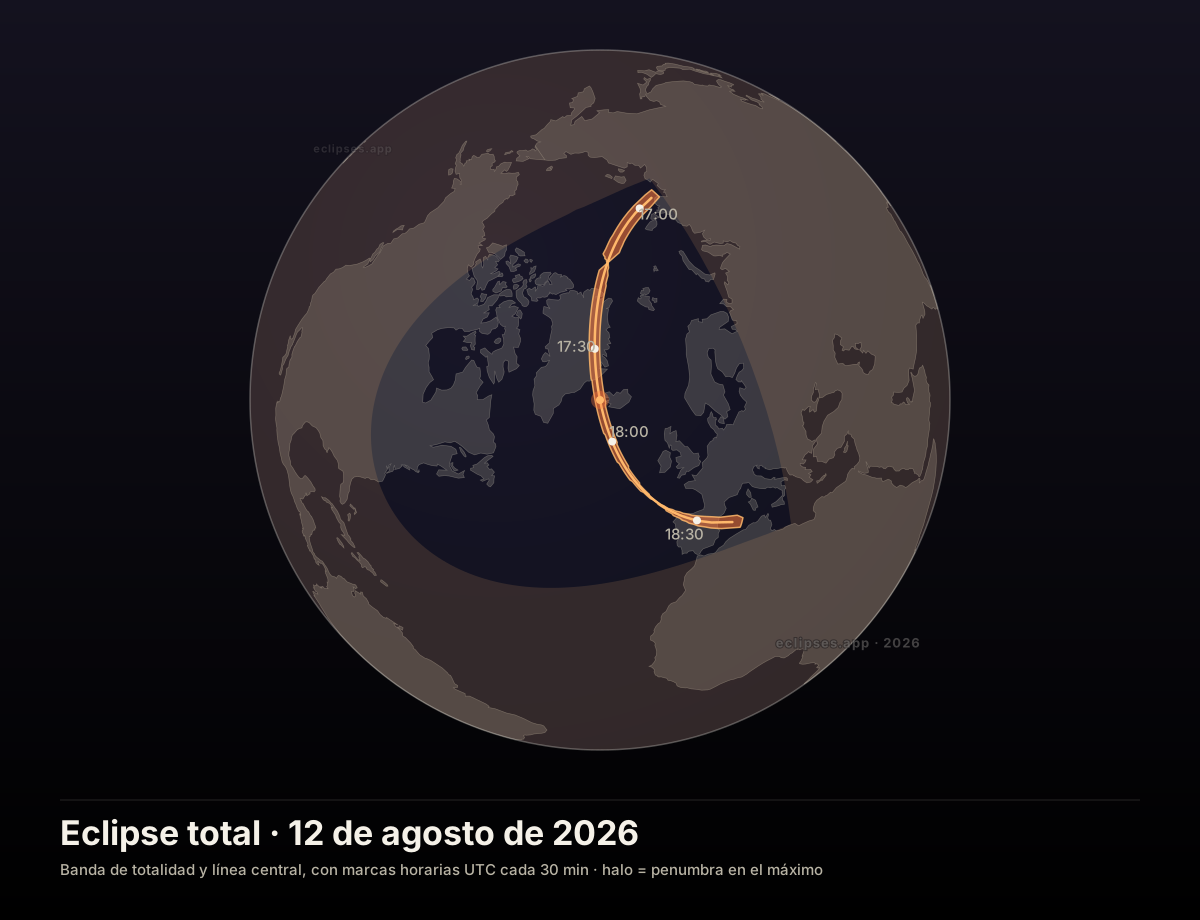
- Begins on Earth
- 15:33:56 UTC
- First totality
- 16:57:24 UTC
- Greatest
- 17:45:55 UTC
- Last totality
- 18:34:25 UTC
- Ends on Earth
- 19:57:59 UTC
These are the moments of the event worldwide, not for one place: the second line is your local time, your device's, not that of the place the eclipse is seen from.
The Spanish cities with the entire totality above the real horizon
In Spain, 149 cities and 3,533 viewpoints see the entire totality above the real horizon — not just the geometric one. See all viewpoints
| # | Spot | Obscuration | Margin (δ) |
|---|---|---|---|
| 1 | Oleiros | 100% | 11.81° |
| 2 | Lalín | 100% | 11.09° |
| 3 | Carballo | 100% | 10.70° |
| 4 | A Coruña | 100% | 10.11° |
| 5 | Lugo | 100% | 9.77° |
| 6 | Narón | 100% | 9.56° |
| 7 | Cambre | 100% | 9.47° |
| 8 | Gijón | 100% | 9.21° |
| 9 | Oviedo | 100% | 9.04° |
| 10 | León | 100% | 8.88° |
| 11 | Zamora | 100% | 8.68° |
| 12 | Ponferrada | 100% | 8.62° |
| 13 | Avilés | 100% | 8.47° |
| 14 | Ferrol | 100% | 8.31° |
| 15 | Medina del Campo | 100% | 8.14° |
Showing 15 of 149.
Near-totality
see the list
In Spain, 87 municipalities fall short of 100% obscuration but stay above 99% — to the naked eye indistinguishable from totality, even though astronomically it isn't.
| # | Spot | Obscuration | Margin (δ) |
|---|---|---|---|
| 1 | Huesca | 99.99% | 5.59° |
| 2 | Alzira | 99.99% | 3.13° |
| 3 | Sitges | 99.99% | 2.73° |
| 4 | Las Rozas de Madrid | 99.98% | 5.92° |
| 5 | Santiago de Compostela | 99.98% | 11.25° |
| 6 | Madrid | 99.98% | 6.84° |
| 7 | Arganda | 99.98% | 6.87° |
| 8 | Rivas-Vaciamadrid | 99.98% | 6.34° |
| 9 | Majadahonda | 99.97% | 6.41° |
| 10 | Carcaixent | 99.97% | 3.36° |
| 11 | Pozuelo de Alarcón | 99.96% | 6.74° |
| 12 | Barañáin | 99.95% | 4.55° |
| 13 | Vilafranca del Penedès | 99.95% | 2.61° |
| 14 | Ribeira | 99.94% | 11.02° |
| 15 | Pamplona | 99.94% | 5.26° |
Showing 15 of 87.
Note: In 3 of these spots (Oleiros, Lalín, and A Coruña), the Sun is still above the horizon when the partial phase ends (C4). In the rest, the Sun has already set before that point — the premise of this eclipse, the «eclipsed sunset».
The planning challenge
The Sun was low on the horizon. Any mountain, building or tree in front was enough to block totality. That's why eclipses.app calculates the real terrain horizon (DEM) — knowing where the Sun is isn't enough.
What happened on the afternoon of August 12, 2026
Inside the path of totality, the Moon covered the entire solar disk for a little over half a minute at some points and more than a minute and a half at others, depending on distance from the centerline. Just before and after came the diamond ring and Baily's beads — the last rays of photosphere squeezing through valleys on the Moon's edge — and between the two, the solar corona, the silvery-white halo the Sun's glare normally hides. The solar filter only came off there, between those two rings: the rest of the event, including the entire partial phase, required certified eclipse glasses (ISO 12312-2) on the whole time.
What made this eclipse different was the time of day: with the Sun between 1.7° and 12° above the horizon during totality, the sky already had sunset colors before it even began, and at most spots with full totality the Sun set during the partial phase — the «eclipsed sunset», an uncommon phenomenon.
The path crossed northern Spain and ended grazing Mallorca, about 294 km wide at its widest point — wider than the 2027 eclipse's path, consistent with how low the Sun was.
Why it was a hard eclipse: terrain decided it
With the Sun so low, any nearby hill, building or tree could block totality even where the geometric calculation said it was visible. Of the 166 Spanish cities inside the path, 149 ended up seeing it in full above the real horizon; the other 17 lost it in the final stretch, blocked by terrain.
Beyond those 166 cities, another 3,533 viewpoints catalogued by eclipses.app were in the same case: full totality above the real horizon. The list of good spots ended up far longer than the list of towns, and there was no way to know it without calculating the real horizon point by point — not by reading a country-scale map of the path.
It was the geometric opposite of the 2027 eclipse: there the Sun will be at 37°-41°, well above any real terrain profile, so terrain stops deciding anything. In 2026 it was the reverse — terrain was exactly what decided who saw it whole and who lost the view in the final second.
What it left behind: a gallery and real timings
After the eclipse, the community started leaving photos in a gallery open to anyone: totality, the diamond ring, Baily's beads, landscapes already under the shadow. It keeps growing with every new submission.
A form also opened to collect real timings from people who were there: the exact time they saw each contact, from where, and with what. That kind of material degrades with the weeks — memories blur, videos get lost — so the form is still open, and every submission helps check the calculation against what people actually observed.
Before the day, we precomputed 560 locations — 394 municipalities with more than 20,000 residents plus 166 districts of the largest cities — plus 18,878 viewpoints, each with its own real terrain horizon, not just the Sun's geometric position. The goal was to offer the most precise calculation we could find for whether an exact spot fell inside the path with totality clear of obstructions: a country-scale map can't tell you that, because the line is decided in meters of terrain, not kilometers of path.
What's next: 2027 and 2028
The next eclipse visible from Spain is on August 2, 2027, total as well, but with the Sun very high (37°-41°) crossing southern Spain: there the problem stops being the horizon and becomes being inside a much narrower path, about 258 km wide.
After that, on January 26, 2028, an annular eclipse crosses Spain, also at sunset. The Moon doesn't quite cover the whole Sun: a ring of light stays visible the entire time, and the solar filter never comes off, however thin the ring looks.
The exact-location calculation still works the same way for both: real terrain horizon, historical and line-of-sight cloud cover, the same 0-to-100 score already used for the 2026 eclipse.
Frequently asked questions
How long did totality last in Spain on August 12, 2026?
It varied by exact spot: around 50 seconds in Torrent, and over a minute and a half (101 s) in León. Duration depended on distance from the centerline, which was wider in this eclipse than in 2027's.
Why was it called «the sunset eclipse»?
Because the Sun was between 1.7° and 12° above the horizon during totality, and at most spots with full totality it set during the partial phase. It's an uncommon phenomenon: the «eclipsed sunset».
Which cities saw full totality?
149 of the 166 Spanish cities inside the path, plus 3,533 catalogued viewpoints. The other 17 cities were inside the path but lost totality to terrain in the final stretch.
Why didn't some cities inside the path see it?
Because the Sun was so low that a nearby hill, building or tree could block the last seconds of totality even where the geometric calculation said it was visible. That's exactly what a country-scale map of the path can't tell you.
Can real 2026 eclipse timings still be submitted?
Yes. The observations form is still open: what time each contact was seen, from where, and with what. The material degrades with the weeks, so the sooner it's sent, the better.
Where can 2026 eclipse photos be seen?
In the community gallery, inside this same section of the site. It keeps receiving new photos.
Was it a total eclipse across all of Spain?
No. Only inside the path, about 294 km wide at its widest point, which crossed northern Spain and grazed Mallorca. Outside it, even very close to the edge, it was a partial eclipse, with the filter on the whole time.
When is the next eclipse visible from Spain?
August 2, 2027, total, with the Sun very high and a narrow path across southern Spain. After that, January 26, 2028, annular, also at sunset.
And from where you are?
This page tells the eclipse for the whole planet. The simulator works it out for one specific spot: with the real terrain horizon, not the geometric one, and with the cloud cover for that date.
Calculate from my location