AUGUST 2, 2027 · TOTAL ECLIPSE
The longest total eclipse of the century
On August 2, 2027, a path of totality crosses half the planet: it's born in the Atlantic, crosses southern Spain, and continues through North Africa, the Arabian Peninsula and the Horn of Africa to the Indian Ocean, reaching its peak in Egypt — over six minutes, the longest totality of the century. In Spain it lasts considerably less, but with the Sun very high: what decides whether you see it isn't the horizon, it's being inside the path.
The path of the shadow
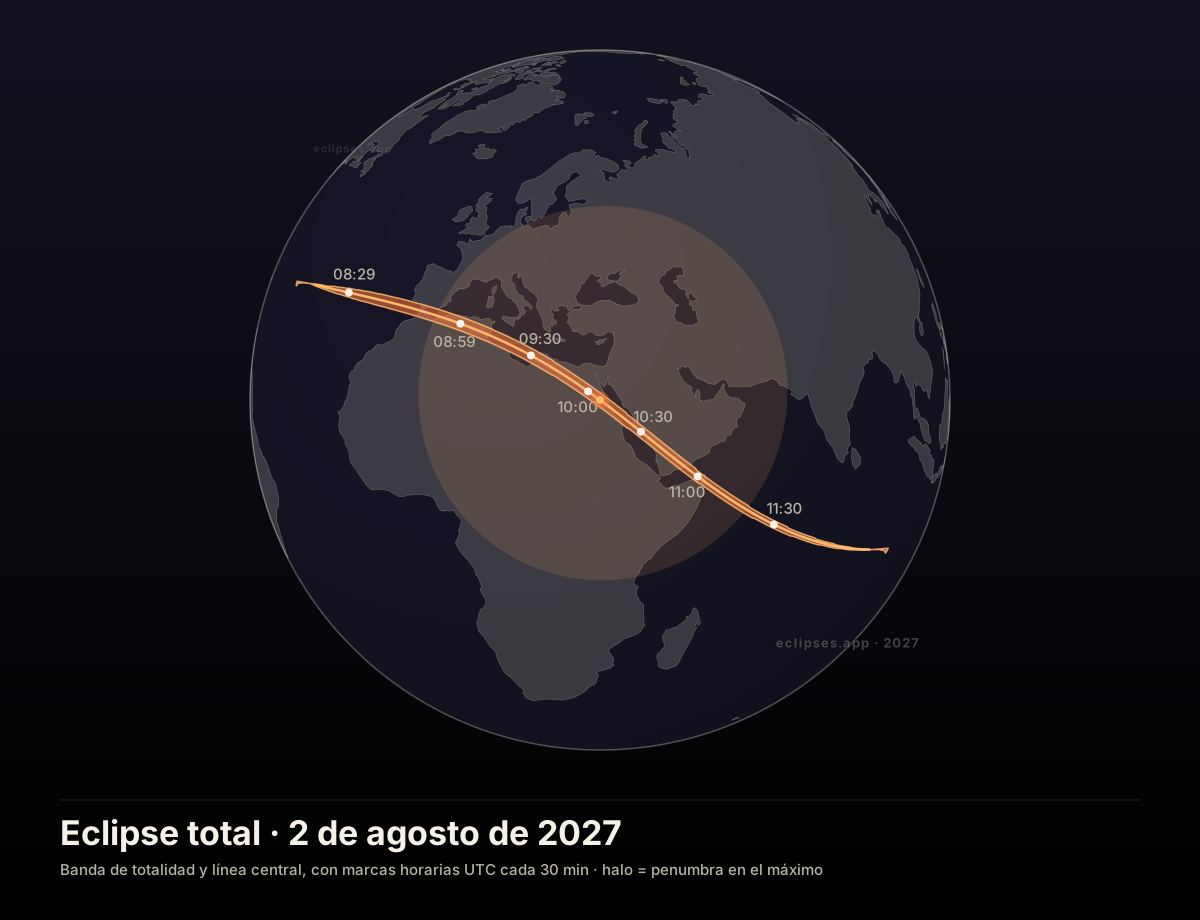
- Begins on Earth
- 07:30:08 UTC
- First totality
- 08:23:23 UTC
- Greatest
- 10:06:40 UTC
- Last totality
- 11:49:56 UTC
- Ends on Earth
- 12:43:12 UTC
These are the moments of the event worldwide, not for one place: the second line is your local time, your device's, not that of the place the eclipse is seen from.
The Spanish cities with the entire totality above the real horizon
In Spain, 38 cities see the entire totality above the real horizon — not just the geometric one. Viewpoints have not been evaluated for this eclipse yet.
| # | Spot | Obscuration | Margin (δ) |
|---|---|---|---|
| 1 | Roquetas de Mar | 100% | 41.52° |
| 2 | El Ejido | 100% | 41.39° |
| 3 | Adra | 100% | 40.84° |
| 4 | Benalmádena | 100% | 39.98° |
| 5 | Torre del Mar | 100% | 39.90° |
| 6 | Torremolinos | 100% | 39.77° |
| 7 | Málaga | 100% | 39.70° |
| 8 | Fuengirola | 100% | 39.60° |
| 9 | Melilla | 100% | 39.47° |
| 10 | San Pedro Alcántara | 100% | 39.37° |
| 11 | Almuñécar | 100% | 39.25° |
| 12 | Estepona | 100% | 39.12° |
| 13 | Marbella | 100% | 38.99° |
| 14 | La Línea de la Concepción | 100% | 38.96° |
| 15 | Alhaurín de la Torre | 100% | 38.91° |
Showing 15 of 38.
Near-totality
see the list
In Spain, 13 municipalities fall short of 100% obscuration but stay above 99% — to the naked eye indistinguishable from totality, even though astronomically it isn't.
| # | Spot | Obscuration | Margin (δ) |
|---|---|---|---|
| 1 | Vícar | 99.98% | 28.70° |
| 2 | Almería | 99.97% | 41.12° |
| 3 | Sanlúcar de Barrameda | 99.95% | 35.07° |
| 4 | Níjar | 99.75% | 39.34° |
| 5 | Lebrija | 99.7% | 37.05° |
| 6 | Antequera | 99.57% | 36.33° |
| 7 | Armilla | 99.27% | 35.52° |
| 8 | Morón de la Frontera | 99.23% | 32.29° |
| 9 | Loja | 99.18% | 37.99° |
| 10 | Granada | 99.14% | 35.06° |
| 11 | Maracena | 99.08% | 37.02° |
| 12 | Los Palacios y Villafranca | 99.06% | 37.58° |
| 13 | Utrera | 99% | 37.50° |
Showing 13 of 13.
Note: In 38 of these spots (Roquetas de Mar, El Ejido, Adra, Benalmádena, Torre del Mar, Torremolinos, Málaga, Fuengirola, Melilla, San Pedro Alcántara, Almuñécar, Estepona, Marbella, La Línea de la Concepción, Alhaurín de la Torre, Nerja, Coín, Mijas, Cadiz, San Fernando, Rota, El Puerto de Santa María, Conil de la Frontera, Ceuta, Puerto Real, Jerez de la Frontera, Algeciras, Vélez-Málaga, Los Barrios, Arcos de la Frontera, Rincón de la Victoria, Motril, Barbate, Ronda, Chiclana de la Frontera, Alhaurín el Grande, San Roque, and Cártama), the Sun is still above the horizon when the partial phase ends (C4). In the rest, the Sun has already set before that point — the premise of this eclipse, the «eclipsed sunset».
The planning challenge
The path of totality is narrow. A kilometer outside and you only get partial. The Sun will be high — horizon calculations matter less, but cloud climatology (August cloud cover) is critical.
What you'll see during totality
A partial eclipse, even one covering 99% of the Sun's disk, is still daytime: the sliver of Sun left is still thousands of times brighter than the full Moon, so certified eclipse glasses (ISO 12312-2) have to stay on the whole time, no exceptions. Totality is different: for a few minutes the Moon covers the entire solar disk, and only then is it safe to look at the Sun with the naked eye.
Just before and after those minutes come the diamond ring and Baily's beads: the last rays of photosphere squeezing through valleys on the Moon's edge. Between the two you can see the solar corona — the silvery-white halo the Sun's glare normally hides — sometimes the pinkish chromosphere, and with luck bright planets and stars in broad daylight. The sky darkens, the temperature drops suddenly, and the horizon turns sunset colors in every direction.
The safety rule doesn't change by location or by year: the solar filter only comes off between the entry and exit diamond rings. Before and after that, even a step away from totality, it's still required.
Why in 2027 it's about where you are, not what's in front of you
During the 2026 eclipse the Sun was very low — between 1.7° and 12° above the horizon during totality — so a nearby hill, building or tree could block the event even where the geometric calculation said it was visible: of the 166 Spanish cities inside the path, only 149 ended up seeing it in full above the real horizon. In 2027 the problem is the opposite.
On August 2, 2027 the Sun will be between 37° and 41° above the horizon during totality in the Spanish cities within the path — well above any real terrain profile in the region — so terrain stops being the deciding factor. All 38 Spanish cities inside the path of totality see it in full above the real horizon: none is blocked by a mountain or a building.
What does decide it is being INSIDE the path. It's about 258 km wide — the NASA canon for this eclipse — and the edge is hard: a kilometer outside it and the eclipse is no longer total. It goes back to being a very deep partial, filter on the whole time, with none of what's described above: no corona, no diamond ring, no darkness.
Another 522 Spanish localities see a partial eclipse without reaching totality. And within the path, not every spot is equal: cities like Benalmádena sit near the top score (100 out of 100), while Roquetas de Mar, Adra, Torre del Mar and El Ejido range between 92 and 97 — full path, high Sun, and good historical August weather.
What eclipses.app calculates for you
Our goal is to offer the most precise calculation you can find of whether an exact spot — yours — falls inside the path of totality, by how much margin, and for how long. A country-scale map of the path isn't enough: the edge is measured in hundreds of meters, not kilometers, and that difference is what separates totality from a very deep partial.
For every location we calculate the real horizon from terrain elevation models — not just the Sun's geometric position —, historical August cloud cover, and cloud cover along the exact line of sight to where the Sun will be, not just the cloud directly overhead. All of it rolls up into a score from 0 to 100.
You can save your location as a plan, with the exact timeline of contacts (C1 through C4) for that spot, and get an alert if the forecast changes as the day gets closer.
How it compares with 2026 and 2028
The total eclipse of August 12, 2026 has already happened. It was this eclipse's geometric opposite: a very low Sun, a wider path, and the terrain horizon deciding who saw it in full and who lost the last stretch to the skyline.
The next one, on January 26, 2028, is annular — not total. The Moon will be a bit farther from Earth and won't quite cover the Sun's disk: a ring of light stays visible the whole time, not a diamond ring followed by darkness. During an annular eclipse the solar filter is NEVER removed, at any point: some photosphere always remains visible, however thin the ring gets.
The point of maximum duration for the entire 2027 eclipse falls in Egypt (25.50°N, 33.17°E), at 10:06:40 UTC, with over six minutes of totality — the longest of the century. That figure is real, but it isn't Spain's: here totality lasts considerably less. The path is born in the Atlantic, crosses southern Spain, continues through North Africa, the Arabian Peninsula and the Horn of Africa, and ends in the Indian Ocean.
Frequently asked questions
How long does totality last in Spain on August 2, 2027?
It depends on the exact spot: duration changes with distance from the center of the path. Either way, it's far less than the six-plus minutes reached in Egypt, where the eclipse's point of maximum duration falls. Calculate your location to see the exact timeline of contacts.
Do I need eclipse glasses in 2027?
Yes, throughout the entire partial phase, before and after totality. The only moment you can look without a filter is between the entry and exit diamond rings, and only if you're inside the path of totality. Outside the path, the filter never comes off at any point in the eclipse.
What happens if I'm a few kilometers from the path but not inside it?
You'll see a partial eclipse, not a total one, no matter how close you are to the edge. The path has a hard boundary: inside, darkness and the solar corona; outside, even by a little, it's still daytime and the filter stays on.
Why did the 2026 eclipse talk so much about the horizon, and this one doesn't?
Because the geometry is reversed. In 2026 the Sun was nearly lying on the horizon (1.7°-12° above it), so nearby terrain could block totality: of the 166 Spanish cities inside the path, only 149 ended up seeing it in full above the real horizon. In 2027 the Sun will be very high (37°-41°), so the horizon stops being the problem — what decides it is being inside the path.
Which Spanish cities see totality in full in 2027?
38 cities fall inside the path, and all 38 see it in full above the real horizon, with no terrain blocking it. Check the table above, with each one's score.
Is an annular eclipse the same as a total one?
No. In an annular eclipse, like the one on January 26, 2028, the Moon doesn't quite cover the whole Sun: a ring of light stays visible at all times and the solar filter is never removed. In a total eclipse, like this one in 2027, there are a few minutes of real darkness when it's safe to look without a filter, inside the path.
Are there recommended viewpoints for 2027?
We haven't calculated any for this eclipse yet — for now we only have the calculation by city. Save your location as a plan and we'll notify you as soon as we add viewpoints.
What is the path of totality?
The zone, about 258 km wide for this eclipse, that the Moon's full shadow crosses. Inside that path the Sun is completely covered for a few minutes; outside it, however close you are, the eclipse is only partial and the filter never comes off.
And from where you are?
This page tells the eclipse for the whole planet. The simulator works it out for one specific spot: with the real terrain horizon, not the geometric one, and with the cloud cover for that date.
Calculate from my location