Help · Astronomer mode
How to use Astronomer mode
Besselian elements, a full sky chart, the physics of totality and data export: the technical depth for anyone who wants more than a verdict.
In three steps
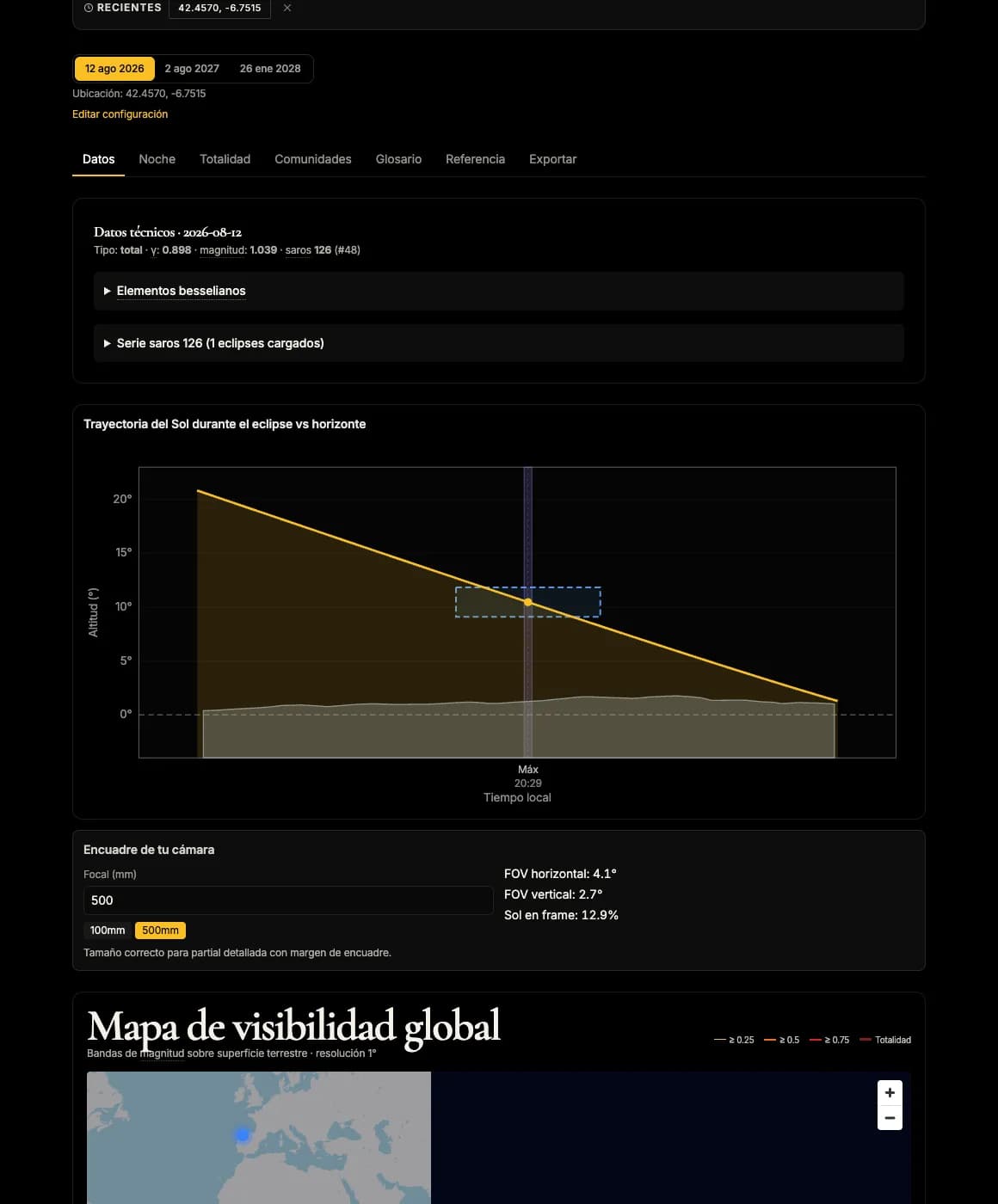
- Check the eclipse's technical data for your location: Besselian elements, magnitude, gamma and saros series.
- Explore the sky chart for the night of the eclipse to plan what else you'll observe, before and after totality.
- Export the data as a PDF once your observation plan is ready.
Technical data: Besselian elements, magnitude and saros
Besselian elements describe the eclipse's geometry in a fundamental reference frame — the same one used by NASA's eclipse canon — and every local contact time for your exact position is derived from them.
Besides gamma (γ, the minimum distance from the shadow axis to Earth's center) and the magnitude (the fraction of the solar diameter covered), the panel shows which saros series the eclipse belongs to: the family of geometrically related eclipses that repeats every 18 years and 11 days.
The solar altitude versus horizon chart overlays your camera's actual framing on the relief silhouette, so the technical data and your photographic planning share the same visual reference.
Your night: sky chart, planets and the Bortle scale
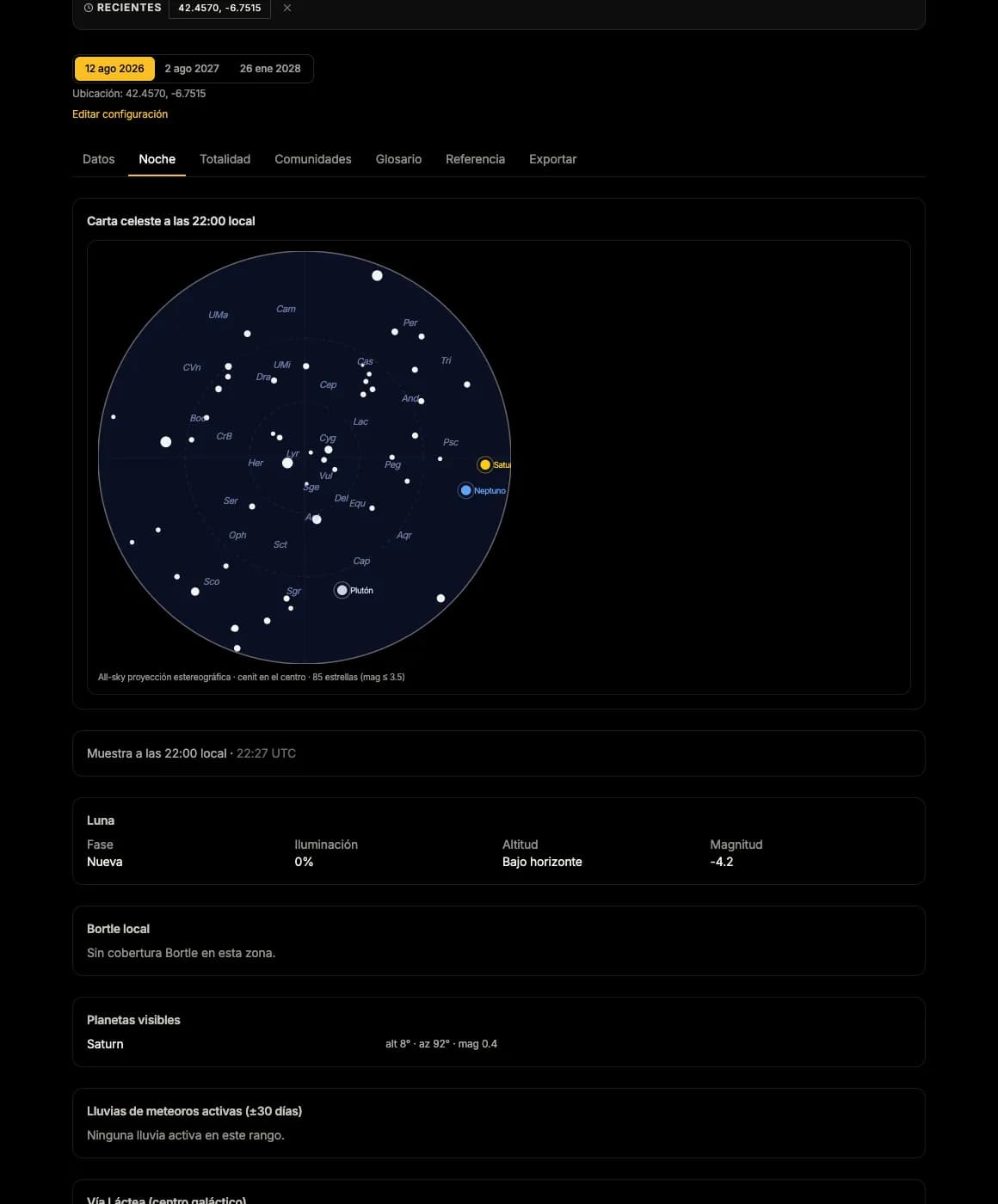
The sky chart places the Moon, the visible planets and the Milky Way's track for the whole night of the observation — not just the totality window — so you can plan the entire field session: what's up before the eclipse and what's left for afterward.
The Bortle scale for your location estimates how much light pollution the local sky has, a factor that in many spots along the path of totality matters more for deep-sky observing than the weather itself.
Totality: chromosphere, corona and shadow
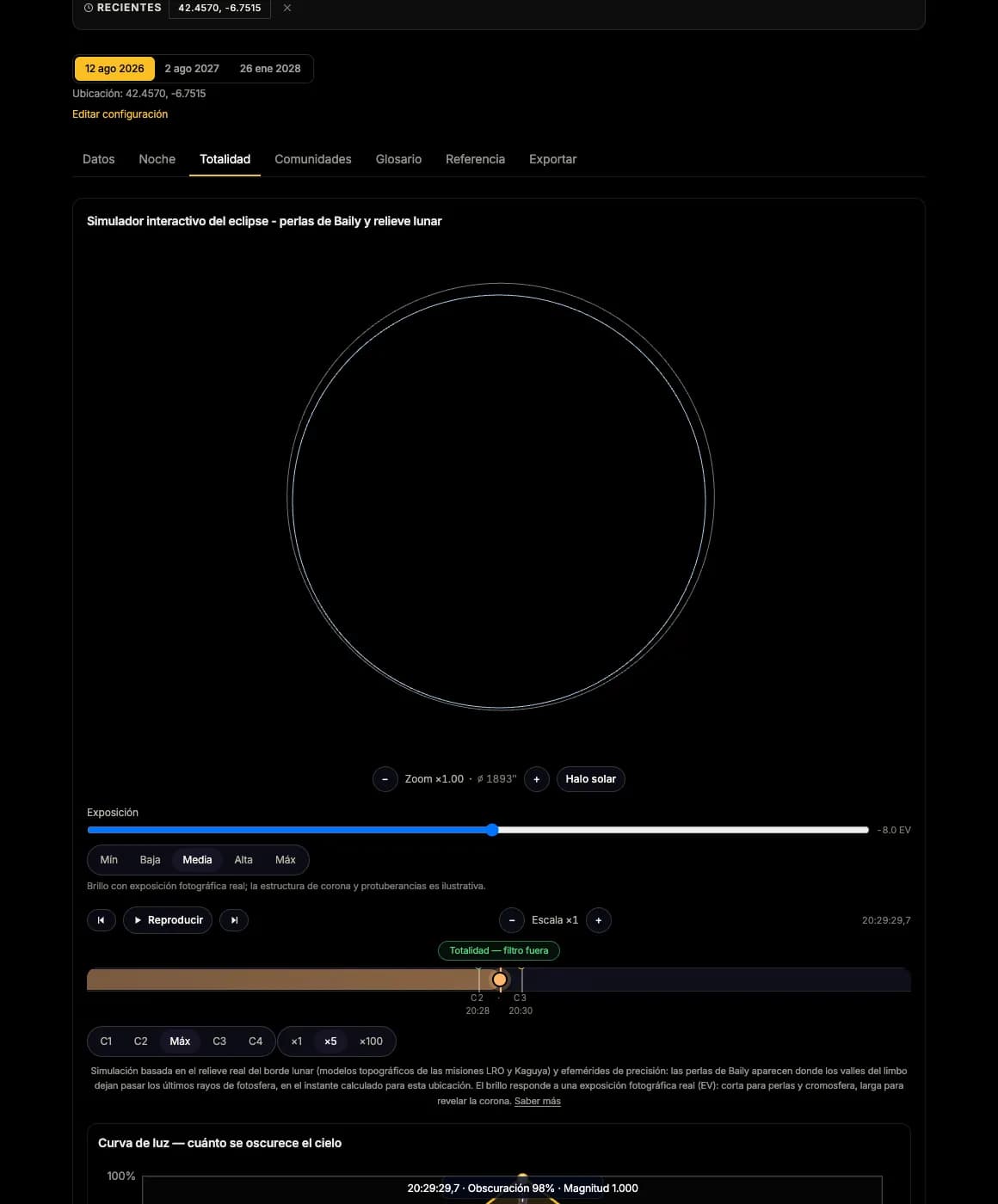
During totality, the panel distinguishes the layers that become visible in sequence: the chromosphere — a pink ring barely a few arcseconds thick —, the prominences that rise from it, and the corona, whose structure and extent depend on the Sun's activity on the actual day of the eclipse.
It also depicts the lunar shadow's advance across the terrain — the speed at which the umbra sweeps over the Earth's surface — so you can see why totality lasts minutes, not hours.
Export: PDF and technical data
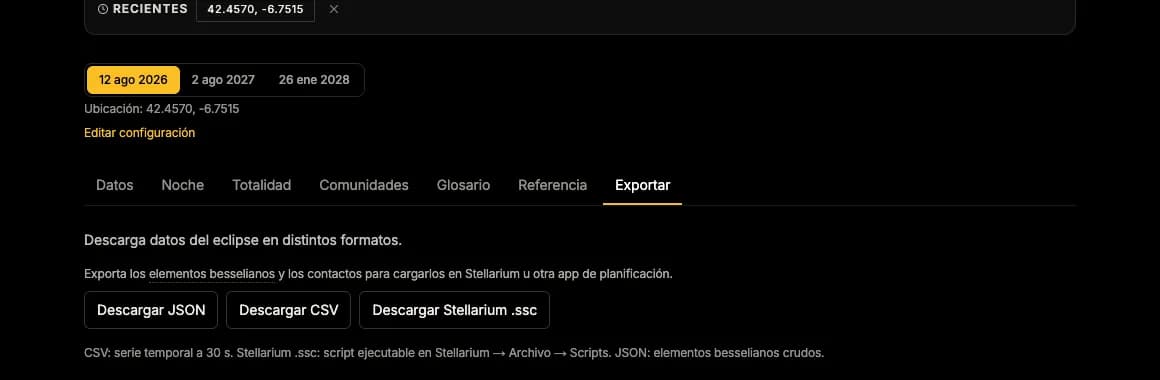
The technical PDF gathers the Besselian elements, the exact contact times for your location, and the magnitude and saros data into a printable document — useful as a field reference or to archive alongside the rest of your observation session.
How we compute this
Besselian elements come from NASA's Five Millennium Canon of eclipses (Espenak), and are reduced to topocentric coordinates for your exact location: the real view from your point, not from Earth's center, which is how contact times are computed by default in generic tables.
The eclipse's magnitude and obscuration are derived from that same Besselian geometry; the saros series is identified from the orbital parameters each eclipse shares with its family.
Those same Besselian elements and that same topocentric reduction feed the simulator's verdict and score: Astronomer mode simply exposes the full technical detail behind that calculation.
Frequently asked questions
- What are Besselian elements, and why do they matter?
- They're the standard representation of an eclipse's geometry in a fundamental reference frame, the same one NASA's eclipse canon uses. Exact contact times for any location on Earth are derived from them.
- Does the Bortle scale account for clouds?
- No — it measures night-sky light pollution, a factor independent of cloud cover, most relevant if you're planning to observe deep-sky objects before or after the eclipse.
- Why does the corona look different in each simulation of the same eclipse?
- Because its real structure and extent depend on the Sun's activity on the actual day of the eclipse, which is only known precisely close to the date — the panel flags it as illustrative, not an exact prediction.
- Can I export the technical data to bring a printed copy?
- Yes, the technical PDF includes Besselian elements, exact contact times, magnitude and saros series in a document designed for field reference.