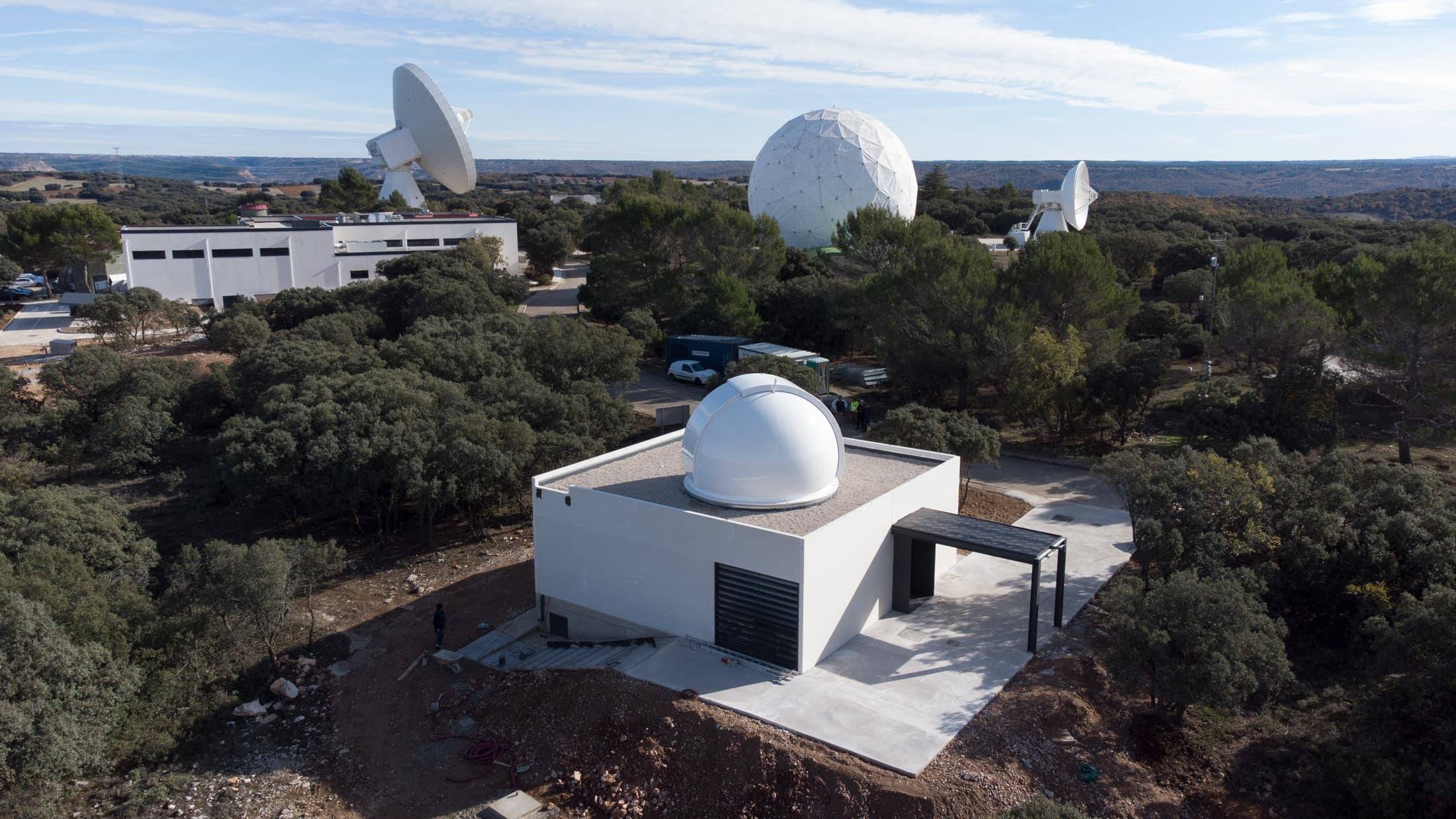
Total solar eclipse of August 12, 2026 in Spain: why Yebes will be the major epicentre of the event
August 12, 2026 will mark a key date for astronomy in Spain. That day a total solar eclipse will be visible from the Iberian Peninsula, an exceptional phenomenon that has not been seen in our country under these conditions for more than a century. To track this event, the Spanish government has chosen the Yebes Observatory, in Guadalajara, as the official tracking centre.
The decision is not random. Yebes will become one of the reference points for scientific outreach, live coverage and institutional tracking of an event with international impact. For eclipses.app, this confirms something very simple: Spain will be one of the best places in the world to experience the 2026 eclipse.
Why the eclipse of August 12, 2026 will be so important
The August 2026 eclipse is not just a spectacular visual event. It is also a first-rate scientific, educational and tourism opportunity.
According to information published by RTVE, the government wants to turn the Yebes Observatory into a venue from which national and international media can broadcast the phenomenon live and explain its relevance. Experts from the Spanish Space Agency, the Instituto de Astrofísica de Canarias and the observatory itself will take part, with the collaboration of Spanish astronauts Pablo Álvarez and Sara García.
The context becomes even stronger when understood within the so-called Eclipse Trio, a sequence of major solar eclipses that will reinforce Spain's role as a leading astronomical destination in Europe.

The Yebes Observatory: why it has been chosen
The Yebes Observatory, run by the Instituto Geográfico Nacional, is one of the country's most important astronomical facilities. Its selection as official tracking centre for the eclipse responds to several factors:
• technical and scientific capacity
• infrastructure suitable for broadcasting and outreach
• strategic value for media and institutional coordination
• symbolic role as a reference astronomical enclave in Spain
From a communications standpoint, Yebes will allow scientific and media coverage to be concentrated in a venue equipped to explain the eclipse to a broad audience with rigour and clarity.

Spain, a global protagonist of the eclipse
One of the most interesting aspects of the event is its international dimension. The Iberian Peninsula will be one of the most relevant inhabited territories for observing this total eclipse, making Spain a global reference for thousands of enthusiasts, travellers, communicators and media.
That means strong interest during those days in searches like:
• where to watch the total solar eclipse in Spain
• best places to watch the eclipse of August 12, 2026
• solar eclipse schedule in Spain
• travelling to Spain to watch the eclipse
For anyone producing content in astronomy, scientific tourism or outreach, the 2026 eclipse is not just news: it is an enormous editorial opportunity.
What impact it will have on science, tourism and outreach
The eclipse of August 12, 2026 can have a strong effect on three fronts:
1. Scientific outreach
Eclipses bring astronomy closer to very broad audiences. They are a perfect gateway to talk about the Sun, the Moon, celestial mechanics and the history of science.
2. Astronomical tourism
Many people will travel to find the best observation spot. This may especially benefit areas with good viewing conditions, low light pollution and rural or nature offerings.
3. International projection of Spain
The institutional organisation of the tracking and the media coverage position Spain as a country capable of leading major astronomical events with global reach.
What role eclipses.app will play
At eclipses.app we don't follow this kind of news only as headlines. We follow them because they help us answer the questions that really matter to the user:
• where to watch the eclipse
• exactly when it will happen
• which areas will have the best visibility
• how to observe it safely
• the difference between partial, annular and total eclipses
• how to plan a trip to experience it at its best
The choice of Yebes reinforces the importance of the 2026 eclipse and confirms that we are looking at one of the great astronomical milestones of the decade in Europe.

Recommendations for those wanting to follow the eclipse
Although practical details are still to be finalised, there are several clear recommendations for anyone who wants to prepare ahead of time:
• follow official and specialised sources
• check visibility maps in advance
• book accommodation early if travelling
• always use certified filters or eclipse glasses to observe the Sun
• avoid improvising on the day in high-traffic areas
Conclusion
The total solar eclipse of August 12, 2026 will be one of the most important astronomical events in Spain in generations. The choice of the Yebes Observatory as official tracking centre demonstrates the scientific and media relevance of the phenomenon, and anticipates a day with huge impact on outreach, tourism and astronomical observation.
For those who love the sky, the date is already marked. And for those not yet following these phenomena closely, it may be the perfect moment to start.
───
Reference source
RTVE: "The Spanish government chooses the Yebes Observatory to track the August 12 eclipse".
───